The Standardized Patient
That Never Sleeps.
Voice-interactive clinical simulation. Photorealistic avatar patients. Physical exam overlay. Automated competency scoring. Available 24/7 — at $2 per session.
Live at ospreyai.web.app · Mr. Robert Johnson demo case available
The Economics Are Undeniable
A trained standardized patient costs $35–$60/hour plus scheduling overhead. Students get a handful of sessions per year.
That session just cost $2.40. A standardized patient costs $40 an hour.
Five Coordinated Layers
Each layer is independently replaceable. HeyGen is a Phase 1 expedient. The Patient AI could run on a different LLM. The architecture is designed for component swapability — not vendor lock-in.
The Patient AI
Claude operating as a specific, constrained patient character. It knows only what the patient would know — and holds back what the patient would withhold. Hidden history releases only when the student builds rapport. It responds emotionally to empathy, becomes guarded with jargon, and never breaks character.
The Avatar Layer
A photorealistic avatar renders the Patient AI's speech as a lip-synced video stream. Phase 1 uses HeyGen's managed service for immediate visual fidelity. Phase 3 migrates to a custom Three.js / Ready Player Me pipeline with full emotional animation and zero per-minute cost.
Physical Exam Overlay
When a student requests an exam ("I'd like to auscultate your heart"), clinical footage plays in the main panel and the actual finding sounds through audio. S3 gallop. Bibasilar crackles. Real findings from validated clinical recordings. The avatar resumes after the overlay. More realistic than any avatar animation.
EvaluatorAI
A completely separate Claude instance receives the full session transcript after the encounter ends. It scores against the case's competency rubric — domain by domain, with specific feedback citing transcript evidence. Missed findings called out explicitly. The evaluator has zero awareness of the Patient AI's instructions.
Case Builder
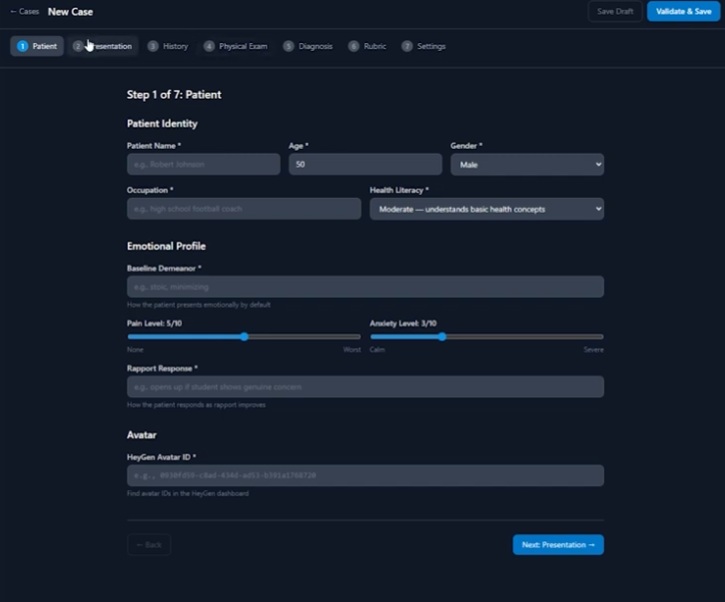
Faculty-facing case authoring platform. Password-protected. Build any clinical scenario: patient demographics, emotional profile, volunteered history, hidden history with release conditions, physical exam findings, competency rubric, and common error patterns. The case schema is EdAI's core IP.
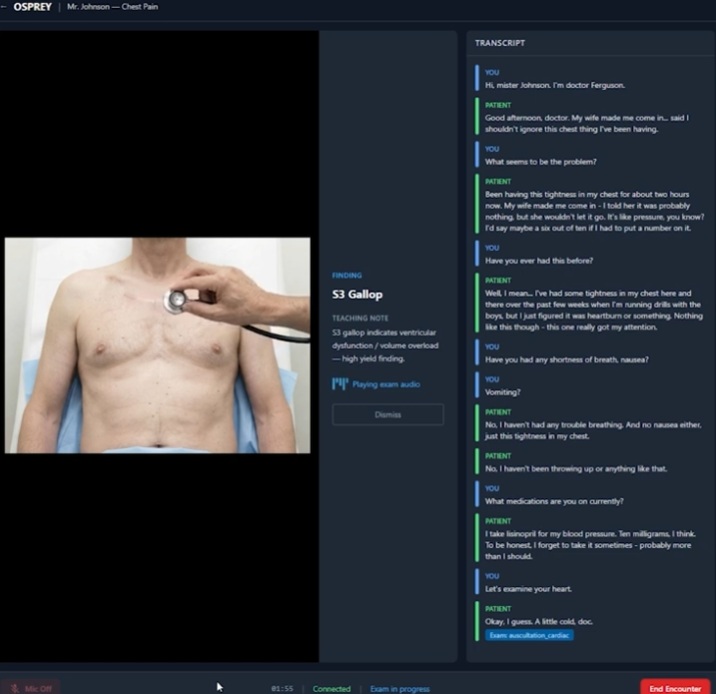
Meet Mr. Johnson
The Phase 1 demo case was chosen deliberately. Every clinician in a funding meeting immediately understands the stakes. The hidden history — three weeks of exertional symptoms he dismissed as heartburn — is a classic "failure to elicit" teaching moment that separates good historians from dangerous ones.
When the student builds rapport (score ≥ 2), Mr. Johnson opens up. When they use jargon, he shuts down. When they ask about family history, he mentions his father had a heart attack at 58 — but only if they ask.
Run the Encounter →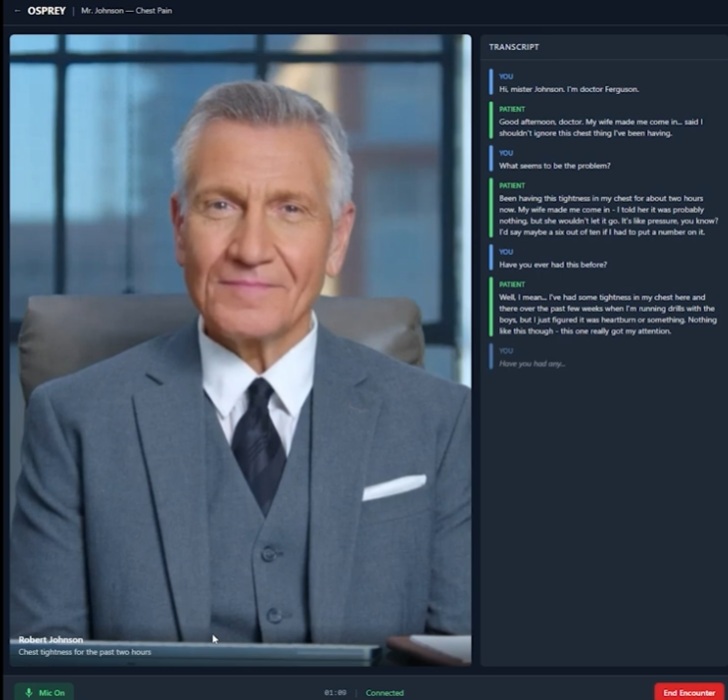
Four Build Phases
The demo proves demand. The infrastructure build proves delivery at scale.
Demo Core
- ·Voice → Patient AI → Avatar pipeline
- ·Mr. Johnson NSTEMI demo case
- ·Physical exam overlays
- ·EvaluatorAI scorecard
- ·Case authoring platform
- ·Firebase / Cloud Run deployment
Case Engine
- ·5 complete clinical cases
- ·Expanded exam action library
- ·Evaluator refinement vs. USMLE/LCME rubrics
- ·Session history & performance tracking
- ·Basic instructor view
Avatar+
- ·Custom Three.js / Ready Player Me pipeline
- ·Full physical exam animation
- ·Emotional state animation (anxiety, pain, guarding)
- ·Zero per-minute streaming cost
- ·Expanded exam overlay library
Instructor Layer
- ·Self-service case authoring UI
- ·Cohort analytics dashboard
- ·LMS integration (Canvas, Moodle)
- ·Institutional licensing & SSO
Who Practicums.ai Is For
Medical Schools
Clinical skills directors and simulation center directors. Budget line: clinical simulation infrastructure. Supplements — never replaces — OSCE and summative SP sessions.
$150–300 / student / year
Residency Programs
Intern preparedness tools. Unlimited case repetitions before real patient encounters. Longitudinal performance tracking across training.
$2–4 / session or institutional license
Nursing & PA/NP Programs
Same architecture, different case libraries. Clinical history-taking is a universal skill. The case builder supports any clinical scenario.
Custom institutional licensing
Ready to See Mr. Johnson?
The demo is live. No account required. Just open the encounter and start talking.
Be the First to Explore EdAI Suite
Get early access to the platform. We'll notify you when demo access opens.