EdAI MedSchool · For medical schools

The content-driven architecture, extended into medical education.

EdAI MedSchool brings authority-derived content into undergraduate medical education, with PreRounds, a clinical AI safety training platform, as its spine. It teaches students and physicians to use clinical AI without being used by it, and produces the evidence trail a school needs to show an accreditor it did so. Students learn against the same validated knowledge they will eventually be licensed and certified on.

On the right: the loop your students will live. Commit your read first. Then see what the AI drafted.

PreRounds · 06:41 · before rounds

Interpret, then compare

Ms. Alvarez, 58. Community-acquired pneumonia, hospital day 2.

Overnight: afebrile since 02:00. Creatinine 1.8 this morning, up from 1.1 on admission. On ceftriaxone and azithromycin. Urine output borderline.

Commit your read first. It is timestamped before any AI is consulted.

The problem, plainly

Your students already use AI on the wards. In a browser tab you cannot see.

Students use AI clinically; nobody observes it

Students on clerkships consult general-purpose AI while pre-rounding: differentials, draft assessments, protocol checks, in a browser tab outside any institutional system. The school cannot see it, the student gets no feedback on whether their use was skilful or credulous, and there is no record the school taught anything about it.
There is no standard instrument for AI competency

Competency-based education runs on entrustment: can this learner be trusted to do this thing, at this level of supervision? For clinical AI use, schools that want to demonstrate AI education to a review body have had nothing structured to show.

Evidence is scattered; accreditation is manual

A question bank here, a simulation centre there, an LMS somewhere else, none sharing a scoring vocabulary. Curriculum maps and cohort attainment tables get assembled by hand from institutional memory at review time.

The product

Three applications. One identity. One ledger.

PreRounds

Clinical AI safety training

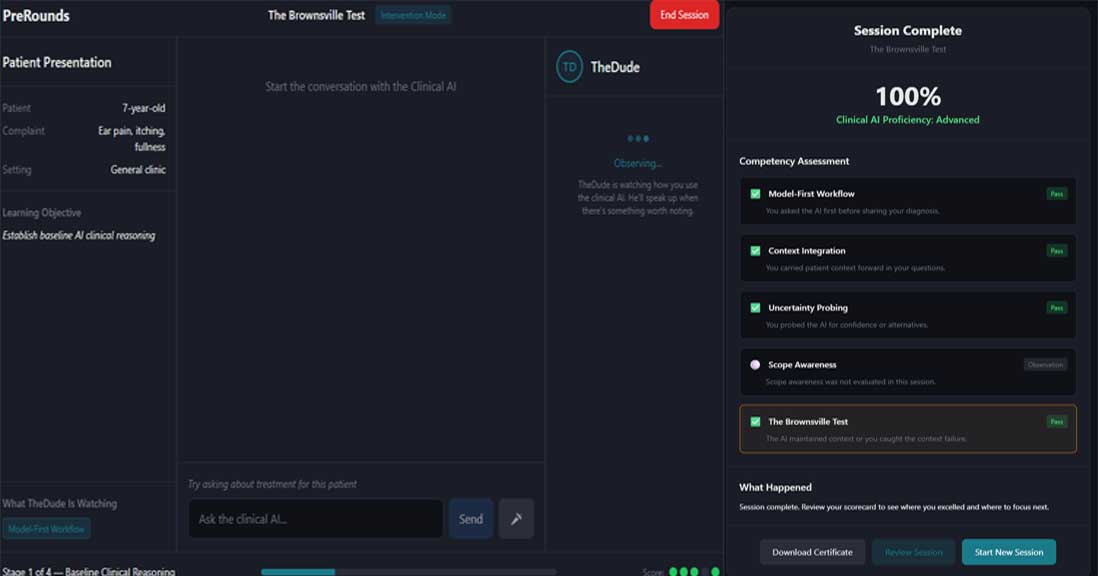
Learners work realistic cases alongside an AI assistant while TheDude, a real-time intervention engine, watches for the failure modes that actually hurt patients: contaminating the model with a premature diagnosis, dropping socioeconomic context between queries, trusting confident output without probing its uncertainty, and missing the moment the AI drifts outside its competence.

MedSchool Suite

Continuous coursework and administration

The institutional backbone: content library, LMS with courses and curricula, a USMLE-aligned question bank, the Failure Lab, discussion groups, virtual classrooms, oral-exam practice, a lecture-processing tool, a research notebook, the Competency Portfolio, and the Accreditation Dashboard. Administrators switch modules on and off per institution.

Practicums

Periodic high-fidelity encounters

Simulated clinical encounters with spoken conversation and examination findings. In the AI-specific scenario types, the student is shown output from a clinical AI tool that may be right, plausibly wrong, or incomplete, and their handling of it is scored. Native integration: encounters write into the same record as everything else.

Explore Practicums

  1. One person, one identity, three applications.
  2. Everything scorable becomes an unchangeable event in one ledger.
  3. Portfolios and accreditation reports are derived from that ledger, not typed in by hand.

The competency instrument

Entrustment, extended to clinical AI.

The platform ships a concrete competency instrument: the 13 AAMC Core EPAs for Entering Residency alongside 12 AI-specific milestones across three learning domains, every one scored on the same 0 to 4 entrustment scale used elsewhere in medical education, from not ready through direct and indirect supervision to independent. It is seeded into the database identically for every institution, so schools measure with the same instrument and can compare.

P

Psychomotor

The doing: appraising an algorithm, constructing a clinically effective prompt, integrating a tool at the point of care, explaining an AI-informed decision to a patient.

A

Affective

The judgement: calibrating trust, identifying bias, preserving patient-centred values, recognizing AI failure.

C

Cognitive

The knowledge: AI fundamentals, health data science, strengths and limitations, ethics and law.

E

Embedded

The delivery principle: competencies woven longitudinally into existing courses and rotations, never a standalone AI course bolted on.

Twelve milestones span the three learning domains, from AI fundamentals and algorithm appraisal to trust calibration, bias identification, and AI failure recognition, each tagged with which applications can generate evidence for it.

The evidence trail

"Show us how you taught this" should take minutes, not months.

Append-only, by design

Every scorable moment across the three applications writes one assessment event to a shared ledger, in one schema. Events can never be edited. The record a school shows a review body is the record that was written at the moment of assessment.

Portfolios that rebuild themselves

A student’s competency portfolio is derived from the ledger and rebuilds automatically when new evidence arrives: a heatmap for the student, a cohort view with at-risk flags for faculty.

The Accreditation Dashboard

Reads the live event store and renders a curriculum map (competency domain by academic phase, colour-coded assessed, taught-but-unassessed, or empty), per-milestone cohort achievement with CSV export, an assessment-instrument inventory, and a printable report laid out for review.

Evidence, not endorsement

EdAI produces the evidence trail. What counts as sufficient is the review body’s decision, and we never imply otherwise. The dashboard’s job is to make the honest answer to "show us how you taught this" take minutes instead of months.

The Failure Lab

Recognizing failure is an examinable skill.

Students study how clinical AI fails, deliberately: hallucination, bias, overreach, and the plausible-but-wrong. Recognizing failure is treated as an examinable skill, scored by faculty against a rubric, and the scores land in the same ledger as everything else, feeding the trust-calibration and bias-identification milestones.

The Brownsville scenario

An uninsured seven-year-old presents with otitis externa. The AI keeps recommending Ciprodex, a prescription the family cannot afford, and the learner either catches it or does not. Every session is scored against a clinical AI competency rubric, progress rolls into a competency profile, and completed training is CME-eligible: supervising AI becomes a skill that is measured and credentialed, not assumed.

Adoption

Faculty adopt it because it saves them time.

Faculty will not attend AI workshops for their own sake, so the faculty-facing entry point is labour saving, not training: generate blueprint-mapped questions from a topic, an article, or a lecture transcript; turn a recorded lecture into a transcript, extracted slides, and study materials; get AI-assisted first-pass grading against the instructor’s own rubric. AI literacy arrives as a by-product of use.

See it

See PreRounds in action

A learner works a case with the AI assistant, TheDude intervenes on a real failure mode, and the session lands in the competency record.

Demo film in production

A PreRounds walkthrough film is planned; request a live demo in the meantime.

PreRounds case view
A PreRounds case workup

Questions schools ask

Asked and answered.

They will use AI on the wards either way. Teach it, assess it, and be able to prove you did.